The industry's hottest female DJ since 2006.
Ravyn Lenae: “Knowing what’s possible has made me even hungrier”
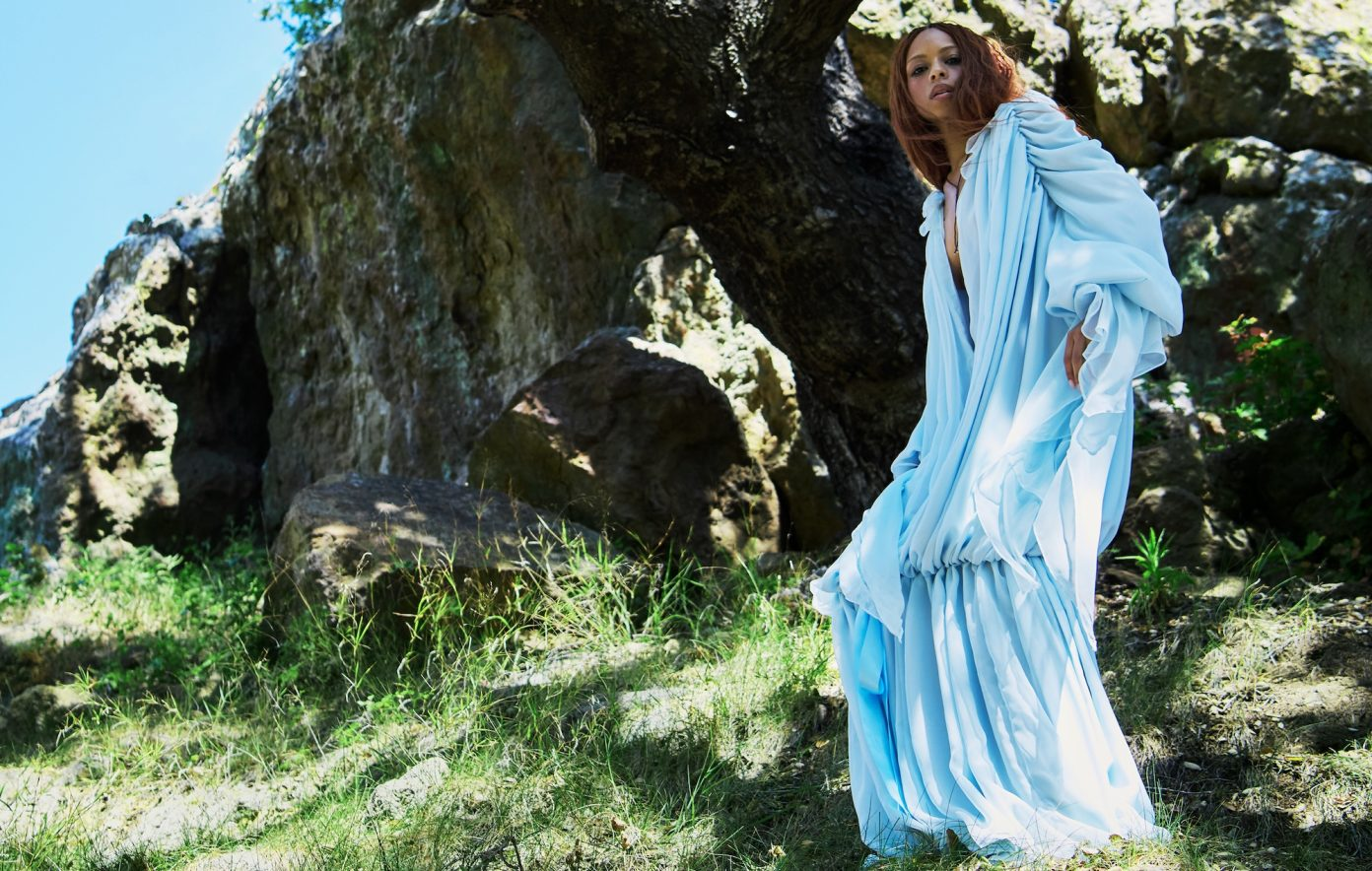
“Oh, she’s up next” appears beneath a recent online performance from Ravyn Lenae, predicting that the singer is about to become a major name.
When ‘Love Me Not’, taken from her 2024 record ‘Bird’s Eye’, suddenly became a viral hit months after arriving, it may have looked like that prediction was coming true overnight. Longtime listeners, however, already understood her importance. Through her work with the Zero Fatigue collective, two studio albums and three EPs, the Chicago artist had established herself as an admired voice in R&B and alternative pop well before a wider audience discovered her.
Lenae is now preparing to share her third album, ‘Blue Island’. Speaking with NME through Zoom from a hotel in Warsaw, she looks relaxed in leopard print, with her recognisable red hair standing out even through the screen. “A lot of the album was made during a really interesting time in my life,” she begins. “I was experiencing the biggest highs of my career whilst trying to manage the inevitable changes that came with it.”
Following the enormous success of ‘Love Me Not’, Lenae quickly moved from respected rising artist to a prominent place in the pop world. She spent the following year performing the song “at every college in America” while learning how to navigate her transformed career. The change was dramatic and arrived alongside the end of a relationship that had lasted four years. It also introduced her to countless listeners who approached her work with less familiarity and, at times, more suspicion. “People were picking apart and questioning my identity and Blackness, and what kind of music I make,” she shares.
Lenae has never allowed her music to settle comfortably inside one category, naturally travelling across R&B, neo soul and indie. She names artists including Santigold, OutKast and Pharrell as major creative guides, admiring musicians who “infuse different genres to make something uniquely universal that can touch everyone”. That approach was challenged by online conversations surrounding ‘Love Me Not’. Some longtime supporters questioned her decision to “do pop”, while other listeners admitted they had assumed she was white after only hearing the song. Having her music and identity examined so intensely felt deeply personal. “I had to do a lot of reconciliation of the self and what I ultimately want to say as an artist,” she reflects.
There were also many joyful parts of the experience. The response strengthened Lenae’s faith in her artistic instincts, supported by what she calls “loud, vibrating validation from the world”. She explains: “Once you get that ‘Job well done, this works!’ you internalise that and take it into the studio with you. I don’t know if you can walk away from something like that unscathed, even in a positive way.”
‘Blue Island’ emerged from that period of personal reflection, balancing the satisfaction of finally arriving with a lingering feeling of uncertainty. Its name comes from the Illinois neighbourhood where Lenae was born, connecting the project to her earliest roots while also representing the transitional place she currently occupies. During her childhood, Blue Island was somewhere her family travelled through rather than a final destination. That makes it an appropriate symbol for a musician “caught between familiar and comfortable worlds in my past, and new worlds I could see in my future”.
That conflict between holding on and moving ahead appears throughout songs such as ‘Saturday Night’ and ‘Familiar Dreams’, which explore memories of past relationships while considering the future. “During times of big change, you’re kind of forced to choose which of the two places you want to be,” she muses. “There’s something antsy and exciting in that in-betweenness; something scary about it.”
“I just want to stay close to my dreams And make space for myself to keep being a person in all of this”
Lenae carried the same emotional friction into the music, placing complete confidence in her intuition and “throwing everything that I love into one bucket”. What emerged could be her boldest and most adventurous album so far. ‘Handle’ and ‘In & Out’ arrive with an energetic rock influence, while the second half embraces pop sounds from the late 1990s and early 2000s on ‘Barriers’ and ‘Saturday Night’. ‘Potential’ moves even deeper into a sharp, metallic style resembling Japanese pop. “No one’s made that connection,” she says as her expression brightens. “I love that!”
Another highlight is ‘Reputation’, an unusual short piece featuring Dominic Fike. “I always wanted that Rihanna and Mikky Ekko moment,” Lenae jokes while pointing to ‘Stay’ as the inspiration. “That song was always so cool to me. It showed us a version of Rihanna, existing naturally, beyond what we’d seen of her so far.”
The louder and more “rambunctious” sections of the record were created deliberately, expressing the urgency Lenae continues to feel about “where I’m sitting right now. Like, this major thing has happened for me, but I still feel like I have to knock down the door”.
Although she had spent her career working towards a breakthrough, finally experiencing one unexpectedly left her afraid that the opportunity could disappear. “I felt like I couldn’t say no to anything,” she admits. That anxiety surfaced in surprisingly precise ways, including repeatedly checking Spotify as the number of people listening to ‘Love Me Not’ at the same time approached 30,000. She found herself calculating how many of those streams might become ticket sales. “I started getting really crazy up in my brain, wanting to ‘turn everybody’,” she reveals. “It’s this weird dichotomy where I now know what’s possible, but that just makes me hungrier.”
 Ravyn Lenae credit: Drew Jarett
“You almost create this factory for yourself, just pushing, pushing, pushing, without any sense of release. That can make it hard to be present or just feel proud of myself. That’s something I’m in therapy for,” she adds, laughing dryly.
The clearest expression of the album’s central message can be found on ‘Baby Girl’, Lenae’s collaboration with Doechii. Through lines including “Breaking them walls / Babygirl why go through the window? / Could never be wrong / Even if you don’t go where everybody goes”, the song provides a personal glimpse into her life as a Black woman unwilling to become “the most neatly packaged, accessible, easy thing”. Delivering that message beside Doechii made it even more meaningful. “That’s my sister,” she says warmly. “I feel so connected with artists who have a strong conviction in who they are. Doechii came out the gates that way; there was never a day when I didn’t believe she was exactly who she says she is.”
Outside the recording studio, Lenae found another way to release that tension through movement. The intense and physical choreography featured in the ‘Handle’ video, created alongside choreographer Akira Uchida, developed naturally as a form of emotional release rather than as a strategic change in direction. “It wasn’t any deliberate decision that ‘I need to do choreo now’,” she jokes. “Things just manifested themselves outwardly, in my body.” Lenae had previously believed she was not “that girl” when it came to choreographed routines, but Uchida’s approach changed her perspective. “I really connected with the shapes he was making; how dance can feel a little quirky and magical.”
Years of performing have also brought Lenae’s larger creative ambitions into greater focus, from leading festival lineups to opening arena concerts for Sabrina Carpenter and Reneé Rapp. “I started to ask myself different questions about the kinds of spaces I want my music to live [in]”, she says. Once she admitted “I want to do arenas”, she began pursuing a “bigger, chancier, more-in-your-face feeling” within her songs. Lenae intends to translate that energy into her forthcoming North American headline tour. “For the first time I have the resources to have stage design. I want people to walk away feeling like they were just in Blue Island.”
This new era represents Lenae finally reaching a level that matches the scale of her longstanding dreams. When asked what advice she would offer the version of herself who had just completed ‘Bird’s Eye’, before everything changed, she pauses briefly before answering. “I just want to stay close to my dreams,” she says. “And make space for myself to keep being a person in all of this.”
Ravyn Lenae’s ‘Blue Island’ arrives August 7 through Atlantic Records.
COMMENTS
You Might Also Like
ADS

Editor's Choice